What Valar's projects would pay in Carbon County, and who would get the money
Reading key: Red bold: a cost, loss or risk for Carbon taxpayers and public budgets Bold: a key tax figure or rule Green bold: money coming in, or good for taxpayers
IF THE COUNTY WANTS TO REFUTE THE TAX MODEL THEY SHOULD SHARE THEIR TAX PLAN
The bottom line: What Valar could mean for Carbon County's budget
Each bar is drawn to the same scale. The economy is the market value of everything produced in the county in 2024 (U.S. Bureau of Economic Analysis); the property tax is everything all local taxing bodies charged in 2025 (Utah State Tax Commission).
More about this chart
Valar's figures are this page's middle results if the campus described to the Trust Lands board were built, averaged over 2027 to 2046: future years beside recent ones, so the shares give a sense of scale, not a forecast. Beside the tax roll, Valar's share would be large; beside the whole economy it is a sliver. Under Utah's certified-rate rule, new property mostly adds to what the taxing bodies collect rather than lowering the rate everyone else pays, which is why a $215,000 home's bill would move by only tens of dollars a year (see below).
Source for the economy: Gross Domestic Product: All Industries in Carbon County, UT (GDPALL49007) (Federal Reserve Bank of St. Louis (FRED), from the U.S. Bureau of Economic Analysis, 2026-02-05)
- a local taxing body's net gain
- the State: aid it would no longer pay, plus the 7% share
S2 is the campus described to the Trust Lands board: reactors, a fuel plant and manufacturing.
More about this chart
No permit application for it was found; its size here is inferred from Valar's Emery County figure. Each bar is a median (middle result) of 100,000 model runs, as a yearly average over tax years 2027-2046, all on one scale. For the county, the Municipal Services Fund and the school district, the bar is a net gain: what that body would collect with Valar minus without, at certified tax rates (Utah's default). A net gain can differ from what Valar pays that body, because certified rates also change what other taxpayers pay. The school district keeps only part of what it levies: the State cuts its aid by what the basic school levy brings in, and the district loses some state guarantee money as value rises. Those amounts, plus 7% of each body's new-growth revenue from centrally assessed property, which the law sends to the State, make the State's bar: mostly school aid the State would no longer pay, not a payment from Valar. The bars are separate medians, not pieces of Valar's tax, and do not add up to it. Valar's tax to all Tax Area 009 taxing bodies would be about $3.06 million a year ($1.23 million to $7.58 million); the water conservancy district's 1.0% of the rate is not shown. If the taxing bodies instead cut rates to keep revenue flat, homes would pay less, the county and the Municipal Services Fund would gain nothing, and the school district's net would be a loss of $438,000 a year.
- In short
- The lease as approved, with nothing built: at most about $3,140 a year in tax for Carbon County government, or $0. One test-scale facility, if built (no such proposal for Carbon was found): about $132,000 a year more. The full campus described to the Trust Lands board, if built: about $1.2 million a year more. Both build cases are averages over 2027-2046. All figures are money coming in; the county's new costs, which no record we read estimates, are not subtracted.
- The lease as approved
- The only Carbon-site approval found in the records read is the state land lease the Trust Lands board approved on September 17, 2026; no record read shows it signed yet. With nothing built, it would bring county government at most about $3,140 a year (about $1,846 to its main property taxes, 0.02% of their 2025 total, and about $1,297 to its Municipal Services Fund), or $0 if the lease does not give Valar exclusive possession (the right to use the land as its own). Lease payments go to Trust Lands, which puts nearly all its revenue in Utah's statewide school fund, not to the county.
- If the campus described to the Trust Lands board were built
- Valar would pay about $3.06 million a year in property tax to all local taxing bodies (the county, the school district and others), on average over 2027-2046. County government would gain about $1.22 million a year, about 9% more than its taxes would otherwise bring in: about $717,000 to its main property taxes and $500,000 to its Municipal Services Fund, which pays for services outside the towns. Most model runs (the middle 80%) give county government $464,000 to $3.23 million a year. Carbon School District would keep about $678,000 a year after the State cuts its school aid. These are 20-year averages; the model has building start between 2028 and 2033. No county permit application for the campus was found in the county's notices through late September 2026, and its size is our estimate from Valar's Emery County figure.
- For a home's tax bill
- If the campus were built, at Utah's yearly default rates a $215,000 home outside the towns (2025 bill: $1,449) would, in our middle result, pay about $22 less in its best year and about $15 more in 2046 than with no Valar (in 2046, from $56 less to $110 more in most runs). Bills fall more only if officials choose lower rates; the county commission sets the county's own. If every taxing body cut its rate to keep its income flat, that home would save about $195 in its best year, the county would gain nothing from Valar, and the school district would lose about $438,000 a year. Either way, Valar would pay part of the area's property tax, shrinking homeowners' share.
- The $106.7 million tax credit in the news
- A tax credit cuts a tax bill. This one works as a rebate: the State's board approved "a 50% rebate in state tax paid" for Valar's Emery County project, not the Carbon site. Each year for 10 years, after that project pays new state taxes, the State would pay Valar back half of them, up to $106.7 million in all. The board's summary projects $213.5 million of new state taxes over those 10 years, so if that happened the State would keep about half and pay Valar back about half. Only taxes and jobs that come after the July 9, 2026 approval count; Valar must meet its job and wage targets and stay in Utah for the 10 years; a local incentive must also be approved; and any overpayment must be paid back. It had not been earned as of late September 2026. It is a state tax rebate, so it does not change Carbon County's property tax.
- What this leaves out
- These figures are only property tax coming in, not money in minus money out. They leave out any costs the county might add, such as roads or emergency services, which no record we read estimates, and a one-time county share of local sales tax on building purchases (at most about $4.74 million in our middle campus result).
For Carbon residents
- a public budget's yearly gain
- one home's bill: the change in 2046
All bars share one dollar scale. The first three are yearly gains for public budgets: the middle result of 100,000 model runs, averaged over 2027-2046, at Utah's yearly default tax rates.
More about this chart
The last is the change in one home's bill in 2046 compared with no Valar: about $15, too thin to draw at this scale. In its best year the bill is about $22 lower.
Under Utah's default rules the new money goes to county services, the school district and the State rather than to lower bills. Bills fall by more only if officials choose lower rates: if every taxing body cut its rate to keep its income flat, this home would save about $195 in its best year, and the county would then gain nothing from Valar. No permit application for the campus was found in the county's notices, and its size is our estimate from Valar's Emery County figure.
The model keeps no year-by-year bill for 2027-2046, so this shows the figures it does keep: medians (middle results) of 100,000 runs, with the middle 80% of runs (10th-90th percentile).
More about this chart
Certified rates, Utah's default, bring in last year's budgeted property tax revenue from this year's values, not counting new growth; levying at or below them needs no truth-in-taxation notice and hearing, while going above needs both. Where the record supports the commissioners' statement: if the taxing bodies chose to cut rates to keep revenue flat, the campus could lower this home's bill by about $195 a year at its peak; even at certified rates the bill is lower in some years, and in runs where a rule starting in 2027 keeps Valar's structures out of new growth, rates fall as Valar builds, with no vote needed (the low end, $56 less in 2046); and because Valar would pay part of the area's total, homeowners' share would be lower than with no Valar. Where it does not, or not yet: no permit application for the campus was found; the commissioners' letter and the county's minutes give no amount, schedule or agreement; and under the default most of the money goes to budgets, so in the middle result the home pays a little more by 2046 as Valar's buildings, and any of its property the State values, lose value and rates rise to make up the difference.
- Carbon schools: about 53 cents of every $100 (0.532%)
- Every other public school in Utah: the other $99.47
Each dot is $1 of every $100 that Utah's Permanent School Fund pays out to public schools.
More about this chart
The money is shared by enrollment, and Carbon School District has 0.532% of the state's weighted pupil units (a per-student funding unit adjusted for need), used here as a stand-in for its enrollment share: about half of one dot.
The lease's $400,000 bonus and rent, about $5,426,786 over 2027-2046 (at the Trust Lands memo's assumed 3% yearly inflation), go to Trust Lands, which puts nearly all its revenue in that fund. The fund keeps the money and pays out part of its earnings yearly: once this lease's money is all in, Carbon schools would get up to about $1,444 a year from it, if the fund paid out 5% a year (an upper-bound assumption). Carbon County government gets $0 from the lease. All Utah school trust land works this way: its income is shared by every public school in the state.
- Paid back to Valar, at most: $106.7 million over 10 years
- Kept by the State: the other half, about $106.7 million
New state taxes projected for the Emery County project over 10 years: $213.5 million
A tax credit cuts a tax bill. This one works as a rebate.
More about this chart
Each year for 10 years, after Valar's Emery County project has paid new state taxes, the State would pay Valar back half of them, up to $106.7 million in all. If the project paid the $213.5 million the State's board projected, the State would keep the other half.
It is not money paid now: it had not been earned as of late September 2026. Only taxes and jobs that come after the July 9, 2026 approval count; Valar must meet its job and wage targets and keep the operation in Utah for 10 years; a local incentive must also be approved; and any overpayment must be paid back. It is for the Emery County project, not the Carbon site, and it does not change Carbon County's property tax. Source: Governor's Office of Economic Development board materials, July 9, 2026.
- primary residences' share
- centrally assessed property's share
Each line is a share of all property taxes charged (billed) in Carbon County that year.
More about this chart
Primary residences are main homes; centrally assessed property (mines, oil and gas, utilities, railroads) is valued by the State Tax Commission. Primary-residence figures were gathered for these six years only, so the years are unevenly spaced. Primary residences paid 19.0% of the taxes in 2008 and 38.5% in 2025; centrally assessed property paid 58.7% and 22.7%. This supports the commissioners' account that the tax burden has shifted toward homeowners. The reports do not separate the causes. Centrally assessed value fell; other changes may also have contributed: locally assessed value, mostly homes and businesses, rose, and in 2020 the county adopted a Municipal Services Fund rate above its certified rate, which the law allows after public notice and a hearing. Source: Utah State Tax Commission annual statistical reports, Tables 2 and 2A.
What it would mean for a home’s tax bill
Valar Watch's draft tax model: results table and added results; Tax Commission annual report 2025, Table 7 (median home value); Tax Commission Report 600, 2025, Tax Area 009
The next five years: 2027 to 2031
Each column is the middle result of the model's runs; the table gives the range, Carbon County government's share and a home's bill.
Year by year, from the same model and the same 100,000 runs as the rest of this page, if the campus described to the Trust Lands board were built. In the model, building starts in a year between 2028 and 2033 (the lease terms call rent years 1 to 5 the ‘Development Phase’) and takes 5 to 15 years, and new property is taxed from the January after it is in place, so the money builds slowly. Each cell gives our middle result; in brackets, the range that holds the middle 80% of runs.
| Year | Valar’s property tax, all local taxing bodies | Carbon County government gains | A $215,000 home’s tax bill, outside the towns |
|---|---|---|---|
| 2027 | $4,268 ($0 to $6,118) | $1,760 ($0 to $2,523) | 2 cents lower |
| 2028 | $4,268 ($0 to $6,118) | $1,760 ($0 to $2,523) | 2 cents lower |
| 2029 | $5,039 ($0 to $684,000) | $2,078 ($0 to $241,000) | 2 cents lower (up to $3.87 lower) |
| 2030 | $5,560 ($0 to $1.83 million) | $2,293 ($0 to $655,000) | 2 cents lower (up to $11.51 lower) |
| 2031 | $168,000 ($0 to $3.14 million) | $50,000 ($0 to $1.14 million) | 63 cents lower (up to $20.55 lower) |
With the lease only and nothing built, the middle result is $0 in each of these years, and most runs stay at or under $6,122 a year to all local taxing bodies together.
Jobs: what’s on the record, and the number that isn’t
- At its July 2025 Emery County town hall, Valar spoke of about 40 employees for roughly 12 months of testing, with local contractors for construction, as ETV News reported. (orig-045)
- Utah's tax credit of up to $106.7 million is for Valar's Emery County project, which the state's board materials project at 275 jobs; it pays out only from new state tax revenue and is tied to job and wage targets. (csite-024)
- In October 2025 the state lab's director was reported saying Valar planned a manufacturing hub in Carbon County in about three years, which could bring hundreds of jobs; no site was named. (loc-034, gov-020)
- For the data centers in Project Beehive, no job figure was found in the public records read, including NPR's 30 September 2026 report on the proposal (as of 2 October 2026). (plan-017)
- For scale: Virginia's legislative audit commission reports, from industry representatives, that 'a typical 250,000-square-foot data center may have approximately 50 full-time workers', about half of them contract workers, earning about $100,000 a year on average; building one puts about 1,500 workers on site at the height of construction, which usually takes 12 to 18 months a building. (Data Centers in Virginia (Report 598), pp. 13-14 (Joint Legislative Audit and Review Commission (JLARC), Virginia General Assembly, 2024-12))
Open question. Job outlooks are hard to forecast while artificial intelligence and automation keep advancing, and no one can honestly claim to know what will happen. Accepting Valar into these two counties and expecting them not to automate is a wager, not a guarantee: the more computing power, the more capable the system, and the more capable the machines it runs. Do you trust them? In the short term, construction jobs would rise while people raise the buildings and local manufacturers make their frames. By the industry's account to Virginia's audit commission, about 1,500 workers are on site at the height of building one data center, and a typical 250,000-square-foot data center, once running, has about 50 full-time workers; the commission itself says a building usually takes 12 to 18 months. When the building stops, most of those jobs end, even if data centers came to fill the land. More land can't be made. Where will we live and what will we do?
Where the numbers come from
Why this page works the numbers out itself
The commissioners' June 29, 2026 letter says Valar's project would add to the county's tax base and lighten homeowners' tax burden, but gives no figures. No Carbon County or State estimate of what these projects would pay, or what they would mean for a home's tax bill, was found in the public records we read.
So this page works the numbers out from the records: the lease, tax rates, assessed values and the State's own projections. Where a key fact is unknown, such as what Valar would build, every possibility is shown, so many results are ranges. These numbers could be far more precise if the county or State published its own estimate and the figures behind it; if one is published, it will be set beside these.
Every number on this page is worked out from these public records. The full list of sources, with links, is at the end of the page.
| Input | What the record gives | Where it comes from |
|---|---|---|
| Lease (approved; signed lease not on record) | SULA 2095: 480 acres of Section 16, T14S R11E, north of Wellington (640 if the Utah National Guard's 160 acres are added), 50 years plus two 25-year extensions, $400,000 bonus, rent $30 an acre in years 1-5 rising to $625 by year 8, purchase option at any time. Approved 17 Sept 2026 on the memo's terms; no record shows it executed. | Trust Lands board packet 17 Sept 2026, pp.18-25; 17 Sept transcript p.33 |
| Lease money | $5,426,786 of bonus and rent in 2027-2046 on 480 acres ($7,102,381 on 640) at the memo's assumed 3% yearly inflation, paid to Trust Lands, which deposits nearly all of its revenue in the statewide Permanent School Fund, whose earnings are shared among all Utah schools by enrollment | memo p.18 (Public Schools Trust); Trust Lands 'Trust Lands to your school' page; arithmetic on the rent schedule |
| Land value | $750 an acre, independent appraisal: $360,000 for 480 acres, $480,000 for 640 | Trust Lands slides 20 Aug 2026 p.40; 17 Sept transcript p.24 |
| Tax area | Parcel 2A-1292-016S (State of Utah, 640 acres) lies in county tax district 9, 'County Outside', which matches Tax Area 009-0000 (inference from matching labels): Carbon County, multicounty and county assessing levies, Carbon School District, Carbon Water Conservancy District, Municipal Services Fund. No redevelopment, Inland Port or other tax-capture area was found covering it (as of late September 2026). | Carbon County GIS 'Parcels by Tax District'; Tax Commission Report 600 (2025) p.41; record csite-029 |
| Tax rates | Tax Area 009 total rate: 0.015884 (2020), 0.014522, 0.012700, 0.011241 (2023), 0.012035, 0.012255 (2025). 2026 county parts 0.002667 + 0.000422 + 0.002180, certified 17 June 2026; 2026 total about 0.012813 (the school district's 2026 rate was not found and is inferred) | Tax Commission Report 600, 2020-2025; Carbon County Commission minutes 17 June 2026 p.3 |
| Who gets each tax dollar | Of the 2026 rate: county general levies 24.2%, Municipal Services Fund 17.0%, Carbon School District 57.8%, water conservancy district 1.0% | arithmetic on the rates above |
| Tax base | Carbon taxable value $2,662,874,222 in 2025, of which centrally assessed $608,548,196 (22.9%), down from $1,487,181,725 (63.2%) in 2008. Oil and gas: -$812,814,097; coal: -$137,447,698. Electric generation: $0 in Carbon (2025) | Tax Commission annual reports 2008 (Tables 1, 1F) and 2025 (Tables 1, 1E, 1F) |
| 2026 drop | Centrally assessed values fell another $48 million in 2026, "primarily due to a gas field sale", per the county's minutes | Carbon County Commission minutes 17 June 2026, pp.2-3 |
| Taxes charged | 2025 property taxes charged in Carbon: $33,962,354 (general county $7,931,918, schools $18,779,411, special districts $4,745,706). Centrally assessed property's share fell from 58.7% (2008) to 22.7% (2025); primary residences' share rose from 19.0% to 38.5% | Tax Commission annual reports 2008 and 2025, Tables 2, 2A, 2F |
| Schools | Carbon School District FY2025 revenue $54,002,145 (53.9% from the state). Basic levy 0.001408 of district levies 0.006913. State guarantee money $567,933 (regular columns) to $1,963,609 (all columns). Debt service 14.6% of district property tax | USBE revenue by source FY2025 p.1; Minimum School Program FY2025 pp.69, 103-104, 112; USBE fund statements (year to June 2024) p.9 |
| Median home | $215,000, taxable $118,250 after the 45% primary-residence exemption; Tax Area 009 bill $1,449.15 at the 2025 rate | Tax Commission annual report 2025, Table 7 |
| Law | Business use of exempt land owes a privilege tax equal to the property tax the land would pay if the user owned it (59-4-101(2)(a)), except a lease without exclusive possession (59-4-103(2)(f)); buildings on state land are taxable (59-2-1103(2)(a)); certified rate = last year's budgeted revenue / this year's value less new growth (59-2-924(4), (7)(b)); new structures without 'new building area related to residential or commercial use' leave new growth from 1 Jan 2027 (59-2-924(1)(u)(ii)(E)); 7% of central new-growth revenue goes to the State (59-2-924.5); basic-levy yield replaces state aid (53F-2-301(5)); the state guarantee on up to 20 levy increments falls as value rises (53F-2-601(2), (7)); a county may not give a nuclear baseload project incentives outside an energy development zone (79-6-1104(2)) | Utah Code, current versions saved from le.utah.gov |
| Percent good | 2026 schedules: machinery (Class 8) 97% falling to 11% by year 11; leasehold improvements (Class 24) 94% to 30% by year 12; long-life property (Class 16) 97% to 9% by year 19 | Tax Commission 2026 Personal Property Classification Guide, Table 1 |
| What Valar would invest | No Carbon figure from Valar was found in the records read. Ranges used: S1, one test-scale facility, $20M-$200M (low end = the $20M gas-fired test heater Valar proposed, and said it would fund, at the state lab); S2, the campus described to the board, $300M-$2.6B (0.23 to 2 times Valar's $1,299,110,000 Emery projection); S3, 'hundreds of reactors', $5.2B-$19.5B, for scale only | Utah Energy Research Board minutes 11 Feb 2026 p.2; GOED board materials 9 July 2026 p.4; Valar mission page |
| Timing | Spending starts 2028-2033 (S2) and lasts 5-15 years; the memo's 'Development Phase' rent covers lease years 1-5 and staff tied the year-7 step to production | memo p.24 (inference) |
The commissioners' letter of June 29, 2026
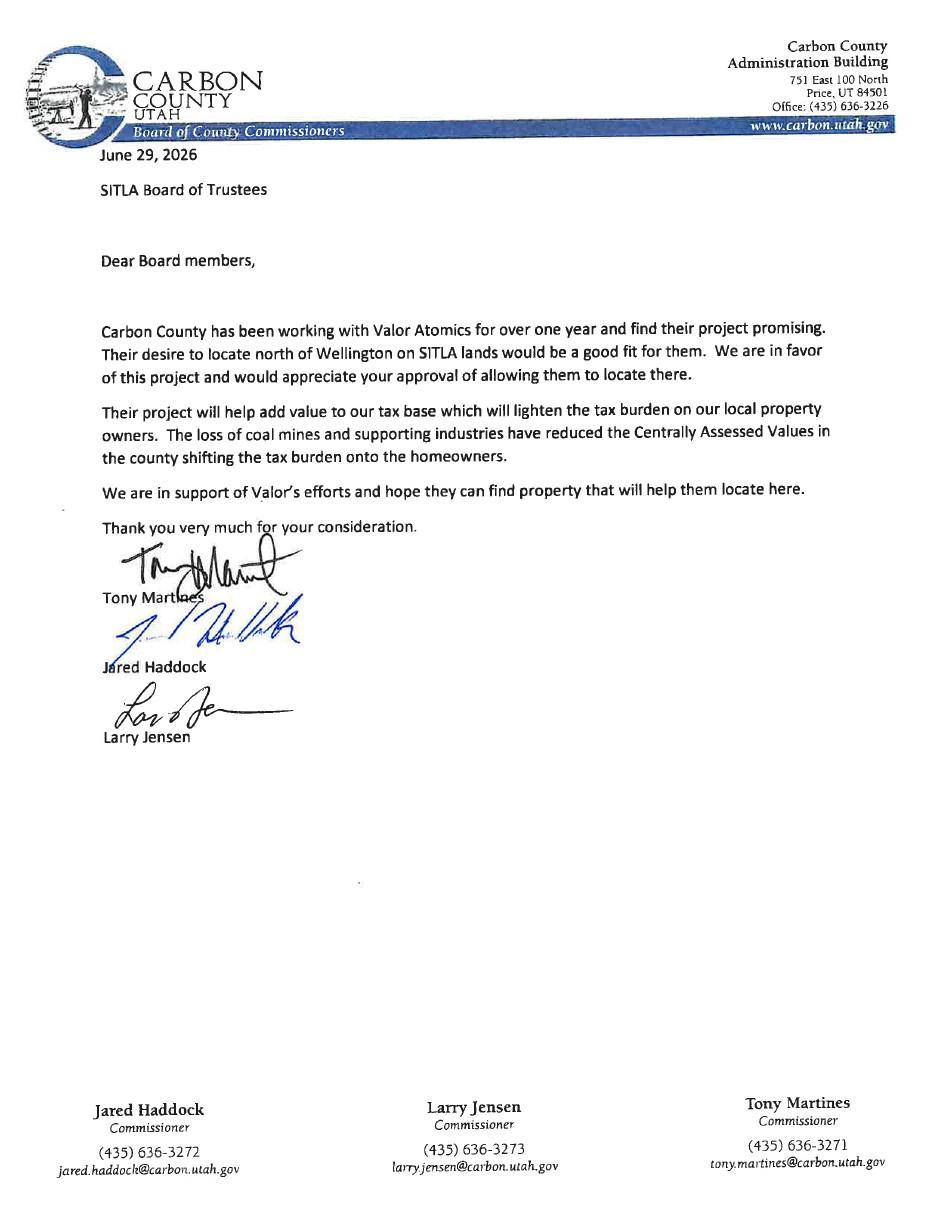
On June 29, 2026, Carbon County's three commissioners wrote that Valar's project would add to the county's tax base and "lighten the tax burden on our local property owners". The state trust land lease the Trust Lands board approved on September 17, 2026 brings all local taxing bodies together at most $7,624 a year in privilege tax (owed for using tax-exempt land for profit, equal to the property tax the land would pay), or $0 if the lease does not give Valar exclusive possession (the right to occupy and use the land as its own). The campus described to the board, for which no county permit application was found, could bring millions a year, most of it adding to county and school budgets under Utah's default rules (part of the school share replaces State aid). A home's bill would move by tens of dollars a year, down some years and up others, falling more only if officials chose to levy below their certified tax rates (the law's yearly default rates).
On June 29, 2026, Carbon County's three commissioners, Tony Martines, Jared Haddock and Larry Jensen, signed a one-page letter to the Trust Lands Administration's Board of Trustees (the letter calls it "SITLA") supporting Valar's request to lease state trust land north of Wellington. The full letter is shown above as printed in Trust Lands' public board packets for August 20, 2026 (page 34) and September 17, 2026 (page 28), the same scan both times. It spells the company 'Valor' (kept here); the company's name is Valar Atomics. Other public statements point the same way. Trust Lands' state review form for the lease says the project "will likely increase local government tax revenues", and the tax model agrees anything built would raise local tax revenue. At the September 17 board meeting Commissioner Jensen said losing mine values from the tax base had "put our homeowners in a real bind" (auto-generated transcript). The county's August 19, 2026 minutes of a Valar update on the company and its work at the San Rafael Energy Lab in Orangeville (Emery County) record that commissioners "highlighted the tax benefits the plant will bring to reduce local residents’ personal property taxes", but do not say which plant. None of these gives an amount, schedule or agreement, and the transcripts record no Valar speaker raising taxes at either Trust Lands board meeting.
June 29, 2026
SITLA Board of Trustees
Dear Board members,
Carbon County has been working with Valor Atomics for over one year and find their project promising. Their desire to locate north of Wellington on SITLA lands would be a good fit for them. We are in favor of this project and would appreciate your approval of allowing them to locate there.
Their project will help add value to our tax base which will lighten the tax burden on our local property owners. The loss of coal mines and supporting industries have reduced the Centrally Assessed Values in the county shifting the tax burden onto the homeowners.
We are in support of Valor's efforts and hope they can find property that will help them locate here.
Thank you very much for your consideration.
Tony Martines Jared Haddock Larry Jensen
What the letter says, beside the record
| The letter | What the public record shows |
|---|---|
| “Carbon County has been working with Valor Atomics for over one year” | All three commissioners spoke for the project at the Trust Lands board on August 20, 2026; the board's approved minutes record Commissioner Haddock "emphasizing the county's long-term collaboration with Valor Atomics from the early site-selection phase". At the same meeting Valar's Max Ukropina said that in 2024 he came to Utah and met state energy and economic development offices, a regional development agency and Carbon County (auto-generated transcript). Trust Lands' staff memo says the Carbon County Commission "has provided a letter of support to the Board". The letter carries no resolution number, meeting date or record of a vote, and none was found in the county's posted agendas and minutes from December 2023 to September 2026; whether a vote was needed is a legal question the records read do not answer. In December 2023 the commission adopted, at a public meeting, Resolution 2023-06 supporting the energy industry, "more specifically nuclear power". The working relationship the letter describes is stated in the commissioners' public words at two board meetings and in Valar's own account of meeting the county in 2024; no county agenda or minutes recording it before Valar's August 19, 2026 presentation to the commission were found; on September 17 Commissioner Jensen said "as a commission, we're very supportive of Valor". A ready-to-send records request on the Take action page asks the county for the letter, any drafts and any meeting records about it. Trust Lands board: transcript, August 20, 2026 (auto-generated); final minutes, August 20, 2026, p.3; transcript, September 17, 2026, p.12; Trust Lands board packet, September 17, 2026, p.27 (staff memo); Carbon County Commission minutes, December 20, 2023; Carbon County Commission notices, agendas and minutes, December 2023 to September 2026 |
| “would appreciate your approval of allowing them to locate there” | On September 17, 2026 the Trust Lands board approved SULA 2095: 480 acres of Section 16, T14S R11E, north of Wellington (640 if the Utah National Guard's 160 acres are added), for 50 years plus two 25-year extensions, with a $400,000 bonus, rent of $30 an acre in years 1-5 rising to $625 by year 8, and an option to buy at any time. No record read shows the lease signed yet. The board granted what the letter asked. The lease gives site control; it does not approve any building. No county permit application for the site was found in the county's notices as of late September 2026; water-right filings and federal reactor (NRC) filings were not searched. Valar may end the lease before construction on 30 days' notice, with Trust Lands keeping the payments. Trust Lands board packet, September 17, 2026, pp.18-25 (terms pp.24-25); Trust Lands board transcript, September 17, 2026, p.33 (motion); Carbon County Commission notices through late September 2026 |
| “Their project will help add value to our tax base” | The letter speaks of "their project"; the board has so far approved only the lease. The land is appraised at $750 an acre ($360,000 for 480 acres, $480,000 for 640). If the lease gives Valar exclusive possession, the privilege tax equals the property tax: $4,047-$7,624 a year for all local taxing bodies, at most $1,846 of it to the county's general levies (0.02% of their 2025 taxes); if not, $0. Buildings and machinery Valar owned there would be taxable though the land is state-owned. A campus like the one described to the Trust Lands board would put an estimated 17.1% of Carbon's 2025 taxable value on the roll at its peak (7.0% to 42.4%), but no investment, output, job or construction figure from Valar for the Carbon site was found in the records read; the Utah investment figures found for Valar ($1,299,110,000 and 275 jobs, and a $20 million test heater at the state lab) are for Emery County. Supports the letter: Utah law taxes what Valar would build there; the land sits in an ordinary tax area (Tax Area 009) with no redevelopment, Inland Port or energy-zone area found that would redirect its taxes; no Valar incentive, tax abatement or development agreement appears in the county commission's notices through September 16, 2026; and a campus that size would be large next to Carbon's tax base, about half the centrally assessed value lost since 2008. Not shown yet: nothing beyond the lease has been approved, and no further application was found. Trust Lands board slides, August 20, 2026, p.40 (appraisal); Utah Code 59-4-101, 59-2-1103; Governor's Office of Economic Development board materials, July 9, 2026, p.4 (Emery figures); Carbon County Commission notices through September 16, 2026; Valar Watch's draft tax model |
| “which will lighten the tax burden on our local property owners” | This page measures the past shift as homeowners' share of all property tax (see the last claim). By that measure, any Valar property on the roll would lower homeowners' share in Tax Area 009, even in years a home's bill rises: every other property there pays the same levies at the same rates as homes, while Valar pays part of the total (the model does not compute the share). Measured as a home's bill in dollars: through 2026 a new building's first value counts as 'new growth', adding revenue to each taxing body at the existing rate without by itself lowering the certified tax rate (it lowers the school debt-service levy a little); from 2027, a new structure adding no residential or commercial building area is not new growth, and if that covers Valar's buildings, their value lowers certified rates as they are built (not settled). If the campus were built, at certified rates a home at Carbon's median value in Tax Area 009 would pay about $15 more in 2046 than with no Valar (from $56 less to $110 more), because rates rise as Valar's buildings, and any of its property the State values, lose value; in its best year at the same rates, about $22 less ($104 to $5 less), and over 2027-2046 all other Carbon taxpayers together would pay about $2.6 million less ($24.3 million less to $7.3 million more). Bills fall more only if taxing bodies levy below certified rates: if all cut rates to keep revenue flat, the home would save about $195 a year at the peak ($85 to $406), about 13% of its 2025 bill; the county and the Municipal Services Fund would then gain nothing from Valar, and the school district would lose $438,000 a year. Supports the letter: a taxing body may levy below its certified rate without the truth-in-taxation notice and hearing, as Carbon County's general levy (0.002495 against a certified 0.002526) and Municipal Services Fund (0.001994 against 0.002026) did in 2024. The commissioners who signed the letter set both rates themselves (the 2026 rates on June 17, 2026); the county's general levies are 24.2% of the estimated 2026 rate and the Municipal Services Fund 17.0%. A larger base also spreads any future budget increase over more value. Not shown: the letter and other statements found give no amount, schedule or plan to cut rates. Utah Code 59-2-919, 59-2-924; Tax Commission Report 600, 2024, Tax Area 009 (certified and adopted rates); Carbon County Commission minutes, June 17, 2026 (2026 rates); Valar Watch's draft tax model |
| “The loss of coal mines and supporting industries have reduced the Centrally Assessed Values” | Centrally assessed property is valued by the State Tax Commission, not the county: mines, oil and gas production, utilities and railroads. In Carbon it fell from $1,487,181,725 (63.2% of taxable value) in 2008 to $608,548,196 (22.9%) in 2025. By the Tax Commission's categories, oil and gas fell about $813 million and coal about $137 million; the Tax Commission's 'electric generation' category was $0 in Carbon in 2025, while its separate 'electric utility' category was $71,569,257. The county's own June 17, 2026 minutes record another $48 million drop in 2026, 'primarily due to a gas field sale'. Supports the letter: the fall is real and large, coal value did fall, and coal mines are centrally assessed, so the letter names the mechanism the law sets. The same tables put most of the fall on oil and gas, not coal (the categories were redefined in 2016, so pairings across that year are approximate). The letter does not say which kind of property fell most, and the tables have no category for coal's "supporting industries" to check that part against. Tax Commission annual reports 2008 (Tables 1, 1F) and 2025 (Tables 1, 1E, 1F); Carbon County Commission minutes, June 17, 2026, pp.2-3; Utah Code 59-2-201(1)(a) |
| “shifting the tax burden onto the homeowners” | Centrally assessed property's share of property taxes charged in Carbon fell from 58.7% (2008) to 22.7% (2025); primary residences' share rose from 19.0% to 38.5%. Utah's certified-rate formula does this on its own: when a large taxpayer's value falls, the rate rises so the same revenue comes from everyone else, without the truth-in-taxation notice and hearing. In June 2026 the county's certified rates rose (general levy 0.002556 to 0.002667) after the $48 million drop. The minutes say the drop "shifted the tax burden slightly" and that the commissioners repeatedly stressed it was "a state-mandated adjustment to balance the budget and keep taxing entities whole", not a county tax increase. Supports the letter: the shift is in the Tax Commission's own tables, and the law produces it. The tables do not separate its causes; other changes in the same years may also have contributed: locally assessed value, mostly homes and businesses, rose, and in 2020 the county adopted a Municipal Services Fund rate above its certified rate (certified 0.000317, adopted 0.002587), which the law allows after public notice and a hearing. The same rule applies to any business property that loses value: as Valar's buildings lose value (and, if the State values its property, its machinery too), rates would rise on other property unless officials cut them, though Valar would still pay part of the total. Tax Commission annual reports 2008 and 2025, Tables 2, 2A, 2F; Tax Commission Report 600, 2020, Tax Area 009; Carbon County Commission minutes, June 17, 2026, pp.2-3; Utah Code 59-2-924 |
What Valar might build, and what each would pay
Each tile is Valar's yearly average property tax over tax years 2027-2046, in dollars charged, to all taxing bodies in Tax Area 009, which covers the lease land: Carbon County and two assessing-and-collecting levies, Carbon School District, the Carbon Water Conservancy District and the county's Municipal Services Fund.
More about this chart
For S1 to S3 (S3 is for scale only), the big number is the median (middle result) of 100,000 model runs, and the range is the middle 80% of runs (10th to 90th percentile). The runs vary what Valar has not said, such as how much it would spend, when, and how its property would be valued, so the range shows what those unknowns allow, not how likely each answer is. The home figure is the 2046 bill of a home at Carbon's median value in Tax Area 009 (valued at $215,000 in 2025, taxed on $118,250) compared with no Valar, at certified tax rates; + means it pays more. Certified rates, Utah's default, bring in last year's budgeted property tax revenue from this year's values, not counting new growth, so new value mostly adds to the taxing bodies' budgets. A home's bill can go up as Valar's buildings, and any of its property the State values, lose value, and down through the school debt levy or a 2027 rule. In the project's favor: the land sits in an ordinary tax area, with no redevelopment, Inland Port or energy-zone area found that would redirect its taxes, and Utah law taxes Valar's buildings and machinery even though the land is state-owned. Not shown in the record: any approval beyond the lease (S0), or any permit application for S1 or S2 in the county's notices.
The lease the Trust Lands board approved on September 17, 2026, with nothing built. Only the use of the land can be taxed, through the privilege tax, and only if the lease gives Valar exclusive possession. Signing of the lease is not yet on record.
$0, or $4,047-$7,624 a year to all local taxing bodies together. Carbon County general levies $0, or $980-$1,846 (at most 0.02% of their taxes); Municipal Services Fund $0, or $689-$1,297; school district $0 to $1,966 after state offsets.
A single small facility costing $20 million to $200 million (the low end is the $20 million cost of a gas-fired test heater Valar proposed, and said it would fund, at the State's San Rafael Energy Lab in Emery County), built over 1-3 years starting 2028-2032 and kept on the roll 5-20 years before removal. No such proposal for Carbon was found; it shows the small end.
$241k a year ($92k to $642k) to all local taxing bodies. County general levies gain $78k ($29k to $214k), 0.8% of their taxes; Municipal Services Fund $54k ($20k to $150k); school district $84k ($26k to $250k) after state offsets. 20-year total $4.82M.
The lease's stated purpose is "an integrated nuclear energy, advanced manufacturing, critical mineral refining, and data center computing campus". The model describes this scenario as reactors, a fuel plant (the staff memo lists TRISO fuel manufacturing among what the campus could include; TRISO fuel is uranium sealed in tiny grains coated with carbon and ceramic layers) and manufacturing. No Carbon cost from Valar was found in the records read, so the scale is inferred: $300M to $2.6B of capital (0.23 to 2 times the $1,299,110,000 it projected for Emery County), spent over 5-15 years starting 2028-2033.
$3.06M a year ($1.23M to $7.58M). County general levies gain $717k ($273k to $1.90M), 7.3% of their taxes (2.7% to 19.6%); Municipal Services Fund $500k ($191k to $1.33M); school district $678k ($208k to $2.20M) after state offsets. 20-year total $61.2M ($30.0M in present value at 5.5%).
Valar's website speaks of 'hundreds of reactors on one Gigasite' and names no site. Capital $5.2B to $19.5B. Shown only for scale; nothing in the record ties it to Carbon.
$22.1M a year ($11.7M to $42.3M). County general levies gain $5.11M ($2.42M to $10.6M), 50.9% of their taxes; school district $7.21M ($3.00M to $15.9M). Peak Valar value would be 151.4% of Carbon's 2025 taxable value.
The laws that could lower or raise what Valar pays, and where the money goes
These Utah laws apply to any business in Valar's position. Of Valar's yearly property taxes, only the land tax could be $0, if the lease does not give exclusive possession; buildings and machinery Valar owned would always be taxed, so its yearly property tax could be $0 only while nothing is built. No Valar tax incentive, tax abatement or development agreement was found in the county commission's notices through September 16, 2026.
Tap a law to open its full description; tap it again to close it.
Could lower what Valar pays
A lease without exclusive possession pays no land taxUtah Code 59-4-101, 59-4-103
State land is not taxed. A business using it for profit pays a 'privilege tax' instead, equal to the property tax the land would pay. But if the lease does not give the business exclusive possession, the right to use the land as its own, no privilege tax is owed at all.
Not settled: the lease's wording was not found in public records. Without exclusive possession it pays $0; with it, about $4,047 to $7,624 a year for the county, the school district and the other local taxing bodies together, if the assessor treats the unbuilt land as used in Valar's business and values it at the $750-an-acre appraisal.
What the law says
No privilege tax is owed on a lease, permit or easement that does not give the user exclusive possession (the right to occupy and use the land as its own). The landlord keeping rights to enter, inspect or approve improvements does not by itself defeat exclusive possession.
Here: Exclusive possession is the main open condition: without it the lease pays $0; with it, about $4,046.76-$7,624.32 a year if the assessor treats the unbuilt land as used in connection with Valar's business and values it at the $750 appraisal.
On the public record: Not found in public records: the lease's possession clause; no signed lease is on record. The board memo does not use the word 'exclusive'; the lease's own terms will decide it.
Machinery is taxed on a shrinking share of its costTax Commission percent-good schedules; Utah Code 59-2-102(19)(c)(iii)
Machinery the county values is taxed on a smaller share of its cost each year as it ages: for production machinery, 97% in its first year, down to 11% by year 11. What happens after the last listed year could not be obtained.
The State's table for power-plant equipment was not obtained, so the figures here use the tables for other machinery.
What the law says
Manufacturing machinery is personal property, valued at its cost times a 'percent good' factor that falls with age. A business's personal property is fully exempt if its total in the county is $25,000 or less (indexed to inflation); above that, only certain items (supplies, inventory, small non-critical items) are exempt.
Here: Valar's machinery would lose taxable value each year: 97% of cost in its first year to 11% by year 11 for machinery (Class 8); 97% to 9% by year 19 for long-life property (Class 16). The $25,000 exemption would not apply to a plant this size.
On the public record: Not obtained: the schedule for power-generating equipment (Class 27) and what applies after the last listed year; the 2026 classification guide prints neither, and no copy of the Tax Commission's separate 2026 valuation schedules is kept here.
A 2027 rule on new buildingsUtah Code 59-2-924 as in force from January 1, 2027, (1)(u)(ii)(E)
From 2027, if a new building the county values adds no floor space 'related to residential or commercial use', its value does not count as 'new growth' (new value that brings in extra money instead of lowering rates). If that covers Valar's buildings, their value would lower everyone's tax rate, Valar's included, as they are built, so the county and schools would gain less.
Not settled: no Tax Commission guidance was found in the records read (its rules and property-tax web pages were not reviewed), and whether a reactor or fuel plant counts as 'commercial use' is open. In the campus case the county's main property taxes would gain about $857,000 a year if the rule never applies and about $604,000 if it always does.
What the law says
New growth counts new real-property value, and centrally assessed value above a three-year average. From 2027, a new structure that adds no 'new building area related to residential or commercial use' is left out; the same clause also deals with increases on property assessed the year before as partly finished new growth. For this rule, assessors may not use permit value for construction in progress.
Here: If the 2027 rule covers Valar's industrial buildings, their value lowers everyone's certified rate as they are built instead of adding revenue for the taxing bodies.
On the public record: Not settled: no Tax Commission guidance on the 2027 rule was found in the records read (its rules and property-tax web pages were not reviewed), including whether a reactor or fuel plant counts as 'commercial use' and how partly finished buildings are treated; the model runs half its cases each way, which is an assumption, not a forecast.
Officials can set rates below the defaultUtah Code 59-2-919
A taxing body, such as the county or the school district, may choose a rate below its default ('certified') rate with no special notice or hearing. That lowers every bill, Valar's included. Going above the default needs a public notice and a hearing, except that, for six years counted from the year before a body first cuts its budget, it may return up to that earlier budget without them.
In 2024 Carbon County's general levy and its Municipal Services Fund were set slightly below the default; in 2020 the Municipal Services Fund was set above it (0.002587 against 0.000317).
What the law says
A taxing body may not levy above its certified rate without public notice and a hearing, except that, within six years counted from the year before it first cuts its budget, it may return up to that earlier budget without them. Levying at or below the certified rate needs no truth-in-taxation notice or hearing.
Here: If Valar's value lets bodies cut rates, they may do so without the truth-in-taxation notice and hearing; keeping the certified rate is the default, and larger cuts in bills depend on that choice.
On the public record: Public: the Tax Commission's Report 600 lists certified and adopted rates. In Tax Area 009 in 2020-2025, the only adopted rate above certified was the Municipal Services Fund in 2020; the county's general levy and the Municipal Services Fund were adopted below certified in 2024.
Sales tax exemptions on equipmentUtah Code 59-12-104(14), (55)
Machinery, equipment, parts and materials a factory uses to make goods for sale can be exempt from sales tax. A separate exemption for equipment that makes an alternative-energy power plant operational covers purchases only through June 30, 2027, and does not cover items used to construct the plant. This is a one-time sales tax on purchases, not property tax.
Not settled: whether fuel made for Valar's own reactors counts as an item 'sold'; whether a reactor counts as 'alternative energy' under Utah's definition was not checked. Campus spending is modeled to start in 2028-2033, after that exemption ends. No exemption for building materials was found in the sections read.
What the law says
The 1% local sales tax is split half by population and half by where goods are received. Machinery, equipment, parts and materials used to make goods for sale can be exempt; an alternative-energy exemption covers purchases only through June 30, 2027 and does not cover property used to build a new facility.
Here: Construction purchases delivered to the site could bring the county a one-time sum, up to $4.74 million in the campus case (median upper bound); no exemption for building materials was found in the sections read. It is not property tax and is left out of every total here.
On the public record: Not settled: whether fuel made for Valar's own reactors is an item 'sold', which decides whether the fuel plant's equipment is exempt.
State tax credits for new jobs and investmentUtah Code 63N-2-103 to 63N-2-105
A tax credit cuts a tax bill. Under this law the State can agree in writing to refund a business part of the new state taxes its project brings in, yearly after they are paid, if it meets agreed targets such as new jobs or investment. Offers are tied to a site and can hinge on a local incentive, possibly a property tax one. It is a state tax rebate, not a change to local property tax.
Valar has one approved for its Emery County project: half of the project's new state taxes for 10 years, up to $106,737,499, which the board called "a 50% rebate in state tax paid". It had not been earned as of late September 2026. No state incentive for the Carbon campus was found as of late September 2026.
What the law says
The State may give a business a credit against state taxes under a written agreement, paid only after the business meets agreed targets, such as new jobs or investment, and the new state tax revenue has been paid; it is worth a share of that new revenue. An offer is tied to a site and can depend on a local incentive as well.
Here: A credit for a Carbon site would lower Valar's state taxes, not local property tax, but a local incentive offered alongside it could be a property tax incentive.
On the public record: Valar has one approved for its Emery County project: a refundable credit of up to $106,737,499, 50% of new state tax revenue for 10 years, which the board's materials call "site specific and subject to local incentive participation" (Governor's Office of Economic Development board materials, July 9, 2026, pp.4-5). No state incentive for the Carbon campus was found as of late September 2026.
Could raise or lower what Valar pays
Who values the plant: the State or the countyUtah Code 59-2-201(1)(a)
A reactor selling power to others would likely be valued by the State Tax Commission as part of a utility; one powering only Valar or its tenants, and a fuel plant, would likely be valued by the county, which values machinery on the shrinking schedules above. Both must use full market value. Which one values it decides whether the 2027 rule (county-valued buildings) can lower its tax, whether falling machinery value raises everyone's default rate (State-valued) or only cuts what taxing bodies collect (county-valued), and whether the 7% rule below applies.
Not settled: no power-sale contract was found in public records, and the Tax Commission could treat Valar's Carbon and Emery property as one unit across county lines.
What the law says
The State Tax Commission values mines, public utilities and property operating across county lines, and assigns the value to tax areas by location. An 'electrical corporation' that sells power to others is a public utility; power made only for the producer's own use or its tenants is excluded.
Here: A Valar reactor selling power to others would likely be centrally assessed; power used only by Valar or its tenants, and a fuel plant, would likely be assessed by the county, unless the Tax Commission treats Valar's Carbon and Emery property as one unit across county lines (not settled). The Tax Commission's 'electric generation' category was $0 in Carbon in 2025; its separate 'electric utility' category was $71,569,257.
On the public record: Not found in public records: any power-sale contract, or whether Valar will sell power to others. Valar told Trust Lands that site control comes before talks with power buyers ('off-takers').
Default tax rates reset every yearUtah Code 59-2-924 (truth in taxation)
Each year Utah sets each taxing body's default rate, its 'certified tax rate', so it brings in the property tax money the body budgeted the year before, plus the tax on new growth such as new buildings. As Valar's buildings, and any of its property the State values, lose value, that rate rises for everyone, Valar included.
In the campus case, most model runs (the middle 80%) put Valar's own 20-year tax between 4.8% lower and 1.0% higher than if the rate never changed; the most extreme mix of inputs gives 29% lower to 10% higher. Both ranges include runs where the 2027 rule listed above applies, so the two effects should not be added together.
What the law says
Each taxing body's certified rate is the property tax revenue it budgeted last year divided by this year's value, leaving out new growth.
Here: Under the rule through 2026, Valar's first-year value adds revenue at the existing rate; later falls in the value of its buildings, and of anything the State values, raise everyone's rate. In the campus case these dynamics move Valar's own 20-year tax by -4.8% to +1.0% in most model runs (the middle 80%), and by -29% to +10% at the extremes (both include runs where the 2027 rule applies), compared with a rate that never changed.
On the public record: Not found in public records: Carbon's 2026 certified-rate worksheets (new growth, prior-year revenue) for each taxing body.
Keep Valar paying, or could raise what it pays
Buildings on state land are still taxedUtah Code 59-2-1101(3), 59-2-1103
While the State owns the land, the land itself is exempt from property tax, but Valar's use of it can still owe the privilege tax above. Buildings and machinery Valar owned on it would still be taxed to Valar.
Settled law. This is why a built campus would pay property tax.
What the law says
State land under lease is exempt, but improvements on it are not. An improvement is taxable even when the business that owns it does not hold title to the land.
Here: Reactor buildings, a fuel plant or factories Valar built would be taxed to Valar at full value, even on state land.
On the public record: Public. The lease requires Valar to remove all improvements if it ends the lease after construction. Not found in public records: whether the assessor would value them as real property or as 'leasehold improvements' (Class 24).
Buying the landUtah Code 59-2-1101(4)(a), 59-2-1103
If Valar bought the land, it would pay a share of that year's tax from the purchase date, and then property tax on the land every year like any other land in the county.
No purchase is on record. Valar may buy all or part of the land at any time under the approved terms. Compared with a lease that pays the privilege tax, the land tax would be about the same; compared with one that pays none, it adds the land's full tax, at most about $7,624 a year at the $750-an-acre appraisal and the highest recent rate (the assessor sets the value).
What the law says
When state land is sold, the buyer pays a share of that year's tax from the sale date. Under an installment contract, the buyer's paid share is taxed as property and the State's remaining share pays privilege tax each year until the last payment.
Here: Valar may buy all or part of the land at any time, and must first buy any part to be used for storing radioactive waste (Trust Lands sets which part); the approved terms do not allow spent fuel to be stored on trust land. The purchase-year tax would be a part-year share, about $7,624 for a full year at the $750 appraisal and the highest rate; the assessor sets the value. After that the land is taxed like any other.
On the public record: No purchase is on record. The staff table prices a year-10 purchase at $10,164,109; that money would go to Trust Lands for the school trust, not the county.
Limit what Carbon County may offer Valar, and could send its tax to the State
State energy zonesUtah Code 79-6-1104
Carbon County or a city may not give financial incentives to a nuclear power project outside a state electrical energy development zone, unless its project area plan was approved before July 1, 2026. If the land were put in such a zone, the added property tax would go to a State fund instead of local budgets, unless an agreement shared it.
No zone covering the lease land, and no project area plan approved before July 1, 2026, was found as of late September 2026. With a zone and no sharing agreement, the county's main property taxes would gain $0 instead of about $717,000 a year in the campus case.
What the law says
A county or city may not offer financial incentives to a nuclear baseload power project outside a designated zone, unless the project's area plan was approved before July 1, 2026. Counties and Trust Lands may apply for a zone; the zone's added property tax then goes to a State fund, subject to agreements.
Here: Carbon County (or a city) may not give financial incentives to a reactor outside a designated zone, unless a project area plan was approved before July 1, 2026 (none found). If the land were put in a designated zone, the county general levies' gain in the campus case would fall from $717,000 a year to $0 without an allocation agreement.
On the public record: No zone covering the lease land was found (as of late September 2026).
Critical minerals zonesUtah Code 79-10-401, 79-10-403
A similar kind of state zone for mining and processing critical minerals, with the same limit on county incentives outside a zone unless a project area plan was approved before May 6, 2026. The lease's stated purpose includes critical mineral refining. Whether uranium or a fuel plant qualifies depends on an official list. In such a zone, the added property tax would go to a State account instead of local budgets, unless an agreement shared it.
No zone covering the lease land was found as of late September 2026.
What the law says
The same structure for critical-mineral extraction or processing projects: no county incentives outside a designated zone unless a project area plan was approved before May 6, 2026, and Trust Lands may propose zones.
Here: The lease's stated purpose includes critical mineral refining. Whether uranium or a fuel plant qualifies depends on the federal or state council list.
On the public record: No zone covering the lease land was found (as of late September 2026).
Would not change Valar's tax bill, but would send the money somewhere other than the usual taxing bodies
Inland Port project areasUtah Code 11-58-601(4), 11-58-603(5)
In an Inland Port project area, the Utah Inland Port Authority can receive up to 75% of the added property tax for 25 years, and its board can add up to 15 more years. Its board can also pay part of that money back to a business, after the business builds or hires, as an incentive.
The lease land is not in the Castle Country project area; the Inland Port Authority counts Valar's Emery County land inside it, though Emery County voted in May 2026 to remove that parcel and the records disagree. With the full 75%, the county's main property taxes would gain about $179,000 a year instead of $717,000 in the campus case.
What the law says
In an Inland Port project area, for parcels outside the Port Authority's own jurisdictional land, the Authority receives up to 75% of the added property tax (the share is set by its board in the project area plan) for 25 years from the date set for each parcel; the board may extend this up to 15 more years. The Authority may also pay a business, after it performs, a share of the property tax it receives from that business's parcel, as a recruitment incentive.
Here: With the maximum 75% capture, the campus case's county general gain would fall from $717k to $179k a year.
On the public record: The lease land is not in the Castle Country project area (Amendment 3, May 2026); the Inland Port Authority counts Valar's Emery acreage inside it, though Emery County voted on May 19, 2026 to remove that parcel and the records disagree.
Community reinvestment project areasUtah Code 17C-1-102(64)
In a community reinvestment project area, the tax on value above a starting level can go to a community reinvestment agency instead of the taxing bodies. Other parts of the law, not read for this page, set how much.
None was found covering the land as of late September 2026: the county's tax map puts the parcel in district 9, 'County Outside'.
What the law says
In a community reinvestment project area, the tax on value above a starting base (the tax increment) can be sent to the community reinvestment agency instead of the taxing bodies; how much is set under other parts of Title 17C (not read for this page).
Here: None was found covering the land as of late September 2026: the county's tax map puts the parcel in district 9, 'County Outside', not a redevelopment area.
On the public record: Public: the county's tax-district map. The assessor's tax-roll entry would confirm it.
The State's basic school tax and school aidUtah Code 53F-2-301(5)
Part of every school tax is a basic levy the State sets. When a district's property value grows, the State cuts its school aid by what that levy brings in, so the district keeps none of that part.
Settled law. It is why Carbon School District would keep only part of the school tax Valar paid.
What the law says
Every district must levy the state-set minimum basic rate. The State pays each district the cost of its basic program minus what that levy raises.
Here: The basic-levy part of Valar's school tax (18% to 20.4% of the school rate) would cut state aid to Carbon School District dollar for dollar; in effect it goes to the State.
On the public record: Public. The district's 2026 rate and levy parts were not found.
State top-up for local school taxesUtah Code 53F-2-601
The State adds money to some of a district's own school levies. As local property value rises, it pays less of that top-up.
The district's 2026-2027 calculation was not obtained.
What the law says
The State guarantees a set amount per weighted pupil unit (a per-student funding unit adjusted for need) for up to 20 increments of a district's voted and board levies. Read with 53F-2-601(7), it pays less as local value rises; a separate 'excess funds' payment in the same subsection is being phased out by FY2029.
Here: Valar's value would reduce Carbon School District's guarantee money, by up to 0.002 times Valar's value a year, capped at what the district receives ($567,933 to $1,963,609 a year, depending on which columns are counted).
On the public record: Not obtained: the district's FY2026-FY2027 guarantee calculation.
7% of new state-valued tax goes to the StateUtah Code 59-2-924.5
From 2026, each year 7% of the tax on growth in property the State values (its value above the average of the previous three years) goes to the State; the next year the taxing body counts all of that growth in its budget.
It would apply only to Valar property the State values: at most 2.9% of Valar's tax in any case modeled.
What the law says
From 2026, 7% of each taxing body's revenue from centrally assessed new growth goes to the State (to the Species Protection Account from 2027).
Here: Applies only to Valar property that is centrally assessed; at most 2.9% of Valar's tax in any case modeled.
On the public record: Public.
Other laws on this page
Privilege taxUtah Code 59-4-101(1)(a), (2)(a), (3)(a)
What the law says
A business that uses tax-exempt property for profit pays a tax equal to the property tax it would owe if it owned the property. It is collected and shared out like property tax.
Here: Valar's use of the leased land, if taxable, would owe acres x $750 x the Tax Area 009 rate: $4,046.76 a year (480 acres at the lowest 2020-2025 rate) up to $7,624.32 (640 acres at the highest), shared by every taxing body by its rate.
On the public record: The rule is public. The county assessor sets the land's value for this tax; the only public figure is the $750-an-acre appraisal.
Value and the home exemptionUtah Code 59-2-103(2)-(3); 59-2-102(13), (40)
What the law says
Property is taxed on its fair market value as of January 1. A primary residence gets a 45% exemption; business and industrial property gets none.
Here: Valar's property would be taxed on 100% of its value; a home on 55%.
On the public record: Public.
How property tax works in Utah
Property tax in one line
Your tax is your property's taxable value times the tax rate where it sits. A 'tax area' is land where the same taxing bodies all levy. The lease land is in Tax Area 009, outside any city, where Carbon County, two assessing-and-collecting levies, Carbon School District, Carbon Water Conservancy District and the county's Municipal Services Fund (for services in the unincorporated area) all levy.
Assessed value
Each January 1 a value is put on every property. A home that is someone's main residence is taxed on 55% of its value (a 45% exemption); business and industrial property is taxed on 100%. Carbon's median home was valued at $215,000 in 2025, so it was taxed on $118,250.
Tax rate
Each taxing body's rate is written as dollars per dollar of value. Tax Area 009's 2025 total was 0.012255: $12,255 a year on each $1 million of business value, and $1,449.15 on the median home. Of the estimated 2026 rate (about 0.012813; the school district's 2026 rate was not found), 57.8% goes to the school district, 24.2% to the county's general levies, 17.0% to the Municipal Services Fund and 1.0% to the water district.
Budgets come first
In Utah the rate follows the budget: each taxing body decides how much property tax it needs, and the rate is set to raise that from the value on the roll. So new construction, which usually counts as new growth, does not by itself lower rates; that depends on each body's budget. (When existing property rises in value, the certified rate does fall; and from 2027 some new structures may not count as new growth, which would lower rates; see New growth.)
Certified tax rate (truth in taxation)
Each year the law works out a 'certified tax rate' for every taxing body: the rate that brings in the property tax revenue the body budgeted last year from this year's values, not counting new growth (Utah Code 59-2-924). Levying at or below it needs no truth-in-taxation notice or hearing; going above it does (59-2-919), except that, within six years counted from the year before a body first cuts its budget, it may return up to that earlier budget without them. This system is called truth in taxation.
New growth
Value that is new this year, such as a new building, is 'new growth'. It is left out when the certified rate is set, so under the rule through 2026 the tax on it is extra money for the taxing bodies at the existing rate, not a lower rate for everyone else. From January 1, 2027, a new structure that adds no 'new building area related to residential or commercial use' will not count as new growth, and the same clause also deals with increases on property assessed the year before as partly finished. Whether a reactor or fuel plant counts as commercial, and how partly finished buildings are treated, is not settled. If the rule covers Valar's buildings, their value lowers everyone's certified rate as they are built.
Centrally assessed and locally assessed property
The State Tax Commission values 'centrally assessed property': mines, oil and gas production, utilities, railroads and property that operates across county lines. The county assessor values everything else, 'locally assessed property'. A Valar reactor selling power to others would likely be centrally assessed; one powering only Valar or its tenants, and a fuel plant, would likely be assessed by the county, unless the Tax Commission treats Valar's Carbon and Emery property as one unit across county lines (not settled). In Carbon, centrally assessed property was 63.2% of taxable value in 2008 and 22.9% in 2025.
How a new plant changes everyone else's rate
Under the rule through 2026, a new plant's first-year value adds revenue instead of cutting the rate: buildings because they count as new growth, machinery because the certified rate uses last year's personal-property roll. After that, as county-valued buildings age and lose taxable value, or State-valued property loses value, the certified rate rises so the same money comes from everyone else. County-valued machinery differs: as it loses value on the State's schedules (97% of cost in its first year, 11% by year 11), the taxing bodies collect less instead of raising the rate. The same formula moved taxes onto homes as coal, oil and gas value fell; it applies to any business's buildings, Valar's included. Even then Valar would still pay part of the total, so homeowners' share of the area's property tax would stay below what it would be with no Valar. From 2027 a new rule may keep buildings like Valar's out of new growth (see New growth).
What would lower bills
Bills fall when taxing bodies levy below their certified rates, or keep budgets flat while value grows. That is a choice each body makes each year; Carbon County and its Municipal Services Fund levied slightly below certified in 2024. The county commission itself sets the county's general levy and the Municipal Services Fund rate (it set the 2026 rates on June 17, 2026); the school district and the water district set their own. A body can also keep part of the new money and cut its rate by the rest; this page shows only the two ends. With no vote at all, the school district's debt-service levy falls a little as value rises, because it only has to cover the debt owed; and if the 2027 rule keeps Valar's industrial buildings out of new growth, their value lowers everyone's certified rate as they are built.
Schools work differently
Part of every school tax dollar is the state-set basic levy. When a district's value rises, that levy raises more locally and the State's aid falls by the same amount (53F-2-301(5)), so the district keeps none of it. The State also pays less 'guarantee' money on some local school levies. Carbon School District got 53.9% of its $54,002,145 FY2025 revenue from the State.
State land is exempt; its business use is not
Trust land owned by the State pays no property tax. A business using it for profit owes a 'privilege tax' equal to what the property tax would be, unless its lease does not give it exclusive possession (59-4-101, 59-4-103). Buildings and machinery the business owns on the land are taxed as ordinary property either way.
More pictures
- * 2018: From 2018 the reports print county-valued property as two columns, real and personal property; they are added together here.
- * 2023: Telecom property moved from State to county valuation this year (2022 law, SB 20).
- centrally assessed: valued by the State Tax Commission
- locally assessed: valued by the county assessor
Taxable value is what the tax rate applies to: 55% of a main residence's value, 100% of business and industrial property.
More about this chart
Centrally assessed property (mines, oil and gas production, utilities, railroads) is valued yearly by the State Tax Commission; locally assessed property is everything the county assessor values, such as homes, farms, shops and other business property. Amounts are dollars of each year, not adjusted for inflation; vehicles, which pay a fee instead, are left out. Centrally assessed value peaked in 2008 at $1.49 billion, 63.2% of Carbon's taxable value; in 2025 it was $0.61 billion, 22.9%, which supports the commissioners' account that it has fallen. Locally assessed value rose from $0.87 billion to $2.05 billion in that time. The county's June 2026 minutes say centrally assessed values fell another $48 million in 2026, "primarily due to a gas field sale"; the Tax Commission has not yet published 2026 totals, so 2026 is not drawn. A Valar reactor selling power to others would likely be centrally assessed; for one powering only Valar or its tenants, or a fuel plant, the law points to county valuation, unless the Tax Commission treats Valar's Carbon and Emery property as one unit across county lines (not settled). Source: Utah State Tax Commission, Property Tax Division annual statistical reports, 2000-2025, Table 1.
- fell from 2008 to 2025
- rose from 2008 to 2025
Centrally assessed property (mines, oil and gas production, utilities, railroads) is valued yearly by the State Tax Commission.
More about this chart
Each bar is the change in one kind's taxable value in Carbon County from 2008 to 2025, in dollars of each year, all on one scale; blue bars fell, the gray bar rose. In all, centrally assessed value fell from $1.49 billion to $0.61 billion. The Tax Commission changed its categories in 2016, so matching 2008 with 2025 is approximate: oil and gas is 2008 'extraction' against 2025 'production' plus 'gathering'; coal is 'coal mines' against 'coal' plus 'coal load-out'; electric power is 'power' against 'electric utility' plus 'electric generation'; railroads is 'transportation' against 'railroad'. Telephone property ($18 million in 2008) has been county-valued since 2023, so it left this count but not the county. The Tax Commission's 'electric generation' category was $0 in Carbon every year from 2016 to 2025. The commissioners wrote that "the loss of coal mines and supporting industries have reduced the Centrally Assessed Values". The record supports a large fall, and coal value did fall, by $137 million; the same tables put most of the fall on oil and gas. The letter does not say which kind fell most. The county's June 2026 minutes give a gas field sale as the main reason for that year's drop. Source: Tax Commission annual reports 2008 and 2025, Tables 1, 1E and 1F.
What would settle the unknowns
- Trust Lands: the signed SULA 2095 lease, above all whether it gives Valar exclusive possession (the main open condition for $0 or up to $7,624 a year now), its signing date and a record that the $400,000 bonus was paid. The Take action page has a ready-to-send records request for the lease file, including the executed lease.
- Carbon County Assessor: the tax-roll entry for parcel 2A-1292-016S (to confirm Tax Area 009), any privilege-tax assessment or personal-property statement for Valar, how buildings a lessee puts on trust land are classified, and the 2026 value of the unincorporated area (the Municipal Services Fund's base).
- Carbon County Clerk-Auditor: the 2026 certified-tax-rate worksheets for each taxing body in Tax Area 009, the 2026 county budget and the 2025 audited financial statements.
- Carbon County: the June 29 letter's drafts and how it was approved.
- Carbon School District: its 2026 tax rate and levy parts, any 2026 truth-in-taxation hearing notice, and its bond schedule.
- Utah State Board of Education: Carbon School District's FY2026-FY2027 state guarantee calculation.
- Utah State Tax Commission: the full 2026 valuation schedules (including power-generating equipment, Class 27), rules R884-24P-20, -32 and -33, any guidance on the 2027 new-structure rule, and whether any Valar property is or will be centrally assessed.
- Valar Atomics: any Carbon investment figure, reactor count, power output or construction schedule, and whether power would be sold to others or used on site.
- Office of Energy Development / Utah Energy Council and the Utah Inland Port Authority: any proposal to put Section 16, T14S R11E in an energy development zone or the Inland Port project area.
- Governor's Office of Economic Opportunity: whether any incentive application names a Carbon County Valar site.
- Trust Lands: Carbon School District's share of Permanent School Fund distributions.
- Valar Watch's tax model: homeowners' share of the area's property tax, with and without Valar, by scenario (not calculated here; the page explains why any Valar tax lowers it).
How these numbers were made
The numbers come from Valar Watch's draft tax model and the official records it cites. Taxes are worked out year by year for 2027-2046, taxing body by taxing body, with Utah's certified-rate formula and the school-finance offsets. No Carbon investment, output or schedule from Valar was found in the records read, so each unknown is a range: capital (S1 $20M-$200M, S2 $300M-$2.6B, S3 $5.2B-$19.5B), start year and build length, taxable share (50-90%), machinery share (40-80%), the State's depreciation schedules, sustaining spending (0-2% a year), the total tax rate (0.011241 to 0.015884, centered on 0.012813), central or county assessment, the 2027 rule (50/50) and whether the land is taxable (50/50). Each built scenario was run 100,000 times with random draws (Monte Carlo); we give the median (the middle result) and the 10th-90th percentile range (the middle 80% of runs). The draw odds are assumptions, not evidence, so these are not probabilities. All combinations of low and high inputs give a wider envelope (S2: $353k to $25.0M a year). Dollars are amounts charged, not adjusted for inflation (Carbon collected 92.7% in 2025); present values use Trust Lands' 5.5% rate. Left out: lease money (not a tax) and the one-time local sales tax on construction. Two models were built independently; in a third check every input was re-checked against saved records and the model rebuilt, matching each within 0.1% and 2.1%.
Sources
- Carbon County Board of Commissioners, letter to the SITLA Board of Trustees, June 29, 2026 · Trust Lands board packets: September 17, 2026, p.28 and August 20, 2026, p.34 (the same scan)
- Trust Lands board packet, September 17, 2026 (Item 10A, SULA 2095 memorandum and terms) · utah.gov/pmn file 1488167, pp.17-29 (terms pp.24-25)
- Trust Lands board packet, August 20, 2026 (Item 9A, SULA 2095) · utah.gov/pmn file 1475881, pp.23-35
- Trust Lands board meeting transcripts, August 20 and September 17, 2026 (auto-generated) · utah.gov/pmn files 1479057 and 1492511
- Trust Lands board final minutes, August 20, 2026 · utah.gov/pmn file 1490469, p.3
- Trust Lands board slides, August 20, 2026 (appraisal) · utah.gov/pmn file 1479233, p.40
- RDCC project record 87203 (SULA 2095 state review form) · Utah Public Lands Policy Coordinating Office
- Carbon County Commission final minutes, June 17, 2026 (certified tax rates) · utah.gov/pmn file 1456991, pp.2-3
- Carbon County Commission final minutes, August 19, 2026 (Valar presentation) · utah.gov/pmn file 1483479, p.3, item 8
- Carbon County Commission minutes, December 20, 2023 (Resolution 2023-06) · utah.gov/pmn file 1065591
- Utah State Tax Commission, Tax Rates by Tax Area (Report 600), 2020-2025 · Tax Area 009-0000: p.41 (2025), p.40 (2024), p.39 (2023), p.41 (2022), p.39 (2021), p.40 (2020)
- Utah State Tax Commission, Property Tax Annual Statistical Reports 2008 and 2025 · 2025: Table 1 p.8, 1E p.16, 1F p.18, 2 p.22, 2A p.24, 2F p.33, 7 p.41, 14 p.50; 2008: Table 1 p.14, 1F p.23, 2 p.26, 2A p.27
- Carbon County GIS, 'Parcels by Tax District' · parcel 2A-1292-016S, district 9 'County Outside'
- Utah State Board of Education, Minimum School Program Summary FY2025 and Total Revenue by Source FY2025 · MSP pp.69, 103-104, 112; revenue p.1
- Utah State Tax Commission, 2026 Personal Property Classification Guide, Table 1 · PDF p.5
- Utah Code 59-4-101 and 59-4-103 (privilege tax) · le.utah.gov
- Utah Code Title 59 Chapter 2 (59-2-102, -103, -201, -801, -919, -924, -924.5, -1101, -1103, -1114, -1115) · le.utah.gov (Parts 1, 2, 8, 9 and 11, and section 59-2-924.5)
- Utah Code 54-2-1 (utility definitions) · le.utah.gov
- Utah Code 53F-2-301 and 53F-2-601 (school finance) · le.utah.gov
- Utah Code 79-6-1104, 79-10 Part 4, 11-58 Part 6, 17C-1-102 (energy zones, critical minerals zones, Inland Port, reinvestment areas) · le.utah.gov
- Utah Code 59-12-204, -205, -211, -104 (local sales tax) · le.utah.gov
- Utah Code 63N-2 Part 1 (state tax credits for new commercial projects) · le.utah.gov
- Governor's Office of Economic Development board materials, July 9, 2026 (Valar, Emery County) · utah.gov/pmn file 1459733, pp.4-5
- Utah Energy Research Board minutes, February 11, 2026 ($20 million test heater) · utah.gov/pmn file 1433079, p.2
- Trust Lands, 'Trust Lands to your school' · trustlands.utah.gov
- Valar Atomics, Mission page · valaratomics.com/mission
- Valar Watch's draft tax model · The model, with the calculations that reproduce every number, kept on file