What the public records show about Valar Atomics in Castle Country
The strongest findings so far, each checked against its source. Every line links to the documents, and each Claims vs Record entry names the record that would settle it.
What you can do about it →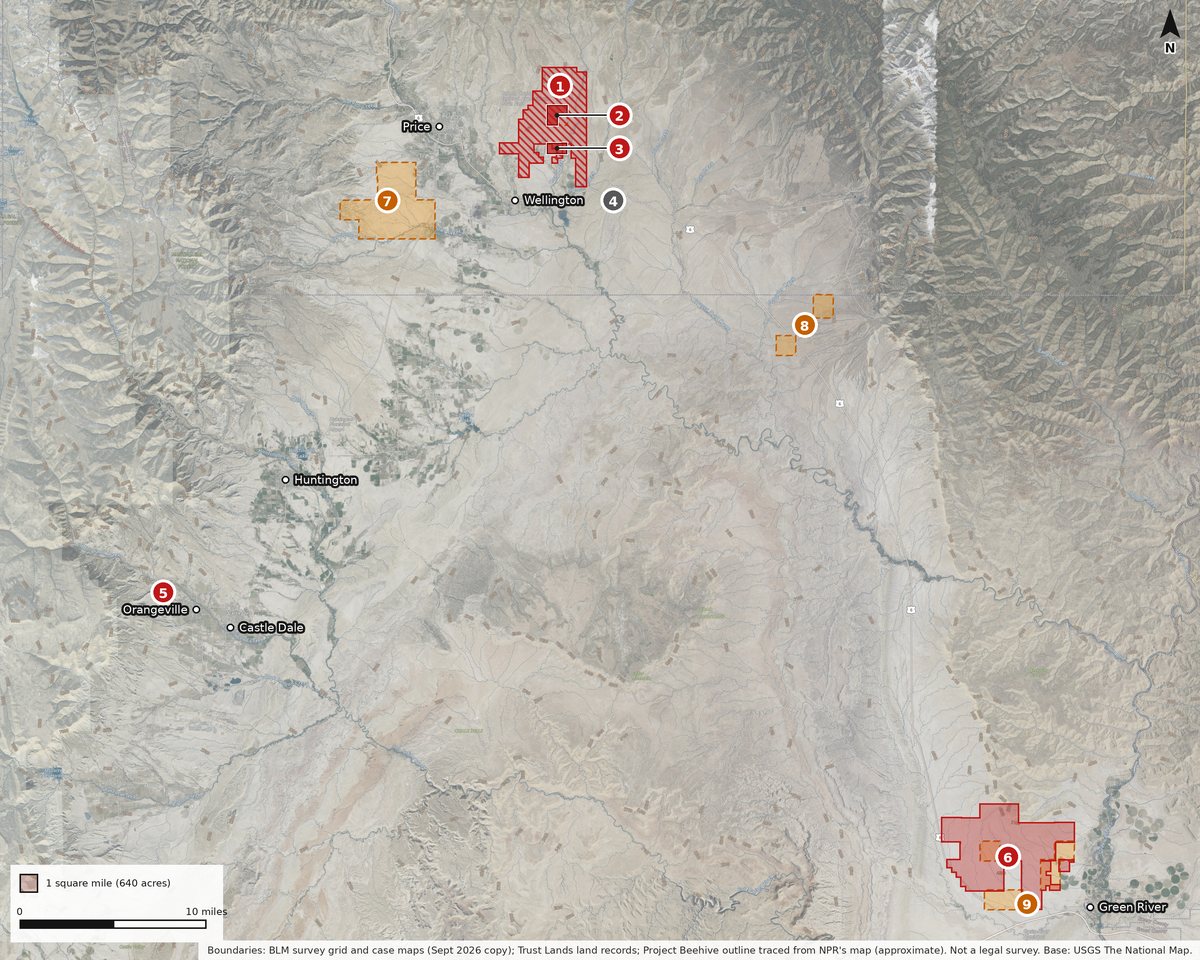
Project Beehive's used fuel, worked out from published numbers
NPR reports Valar's Project Beehive would run about 456 small reactors near Price. By our math, they would leave the radioactive leftovers of 6 to 10 large U.S. reactors every year, in less uranium but much more bulk. Holding one used fuel pebble for five minutes, a day after it leaves a reactor, would give the whole body about 30 times the top of a CT scan's range; a year later, about one scan's worth. (The pebble is our stand-in: Valar has not said what shape Beehive's fuel would take.)
Open Radiation Exposure →County transparencyThe Planning Commission would decide Valar's county permit. A Valar presentation was added to its next agenda four days out.
Under Carbon County's 2023 Development Code, the Planning Commission's appointed members, named on the County Transparency page, approve or deny the conditional use permit the state's lease memo says Valar needs. On October 2, the notice for their October 6 meeting, posted September 23, was edited to add a Valar presentation. As of that day, no Valar application had appeared in their notices, and no separate notice of the change had been posted on the state's public notice website. Notices for their earlier meetings since June went up 25 to 29 days ahead, and one earlier agenda amendment about 8 days ahead. The edit met Utah's 24-hour minimum and is logged in the notice's public revision history; as on all their agendas since June, no general public comment item is listed.
Open County Transparency →TaxesWhat Valar could mean for Carbon County's budgets and a home's tax bill
If the campus described to the Trust Lands board were built (no county permit application has appeared in the planners' public notices), our model's middle result gives public budgets millions a year on average over 2027-2046, about $1.22 million of it to county government, before any new county costs, which no record we read estimates. At Utah's default rates, a $215,000 home outside the towns would pay about $22 less in its best year and about $15 more in 2046 than with no Valar; bills fall by more only if officials choose lower rates. The lease as approved, with nothing built, would bring county government at most about $3,140 a year, or $0 if the lease does not give Valar exclusive possession of the land.
For Carbon residents, on the Taxes page →HeatProject Beehive's 456 reactors would make about as much heat as 7 or 8 big U.S. reactors
NPR's figures are electricity: about 9.6 gigawatts, or 456 reactors of 25 megawatts. Reactors make about 2 to 3 times as much heat as electricity, so by our math Beehive would make about 24 or 28.5 gigawatts of heat, one for each NPR figure: about what 7 or 8 big U.S. reactors make (21.3 to 34.5 gigawatts, or 6 to 10 reactors, depending on the unknowns). Its used fuel keeps giving off heat, as all used fuel does: one year's used fuel would still give off about 280 or 330 kilowatts ten years later (220 to 450 depending on the unknowns). In Valar's favor, studies find it gives off less heat for each unit of electricity made than big reactors' used fuel, and our numbers agree unless the reactors turn the least of their heat into electricity.
Open the heat section →The timeline: Valar's website, its moves, and government dealingsDated records in three lanes, each linked to its source. 48 dated records.OpenClose
Government items carrying the marker had no public record found from the time (no agenda, notice or posting found), or were public without Valar's name; each item gives its date and links its record. 'No public notice found' means none on the state's notice website.
Findings
The reactor's public safety agreement lists different fuel than DOE approved shipping to it.
Valar's safety agreement for Ward 250 says its fuel is 4.95% enriched uranium, and its public copy has not changed since at least November 2025. DOE's own shipping review approved sending the reactor HALEU fuel, enriched up to 19.9%. The agreement is marked 'Draft' and says fuel-design changes will be carried into a later safety analysis; that analysis, which may have been updated, was not found in public records.
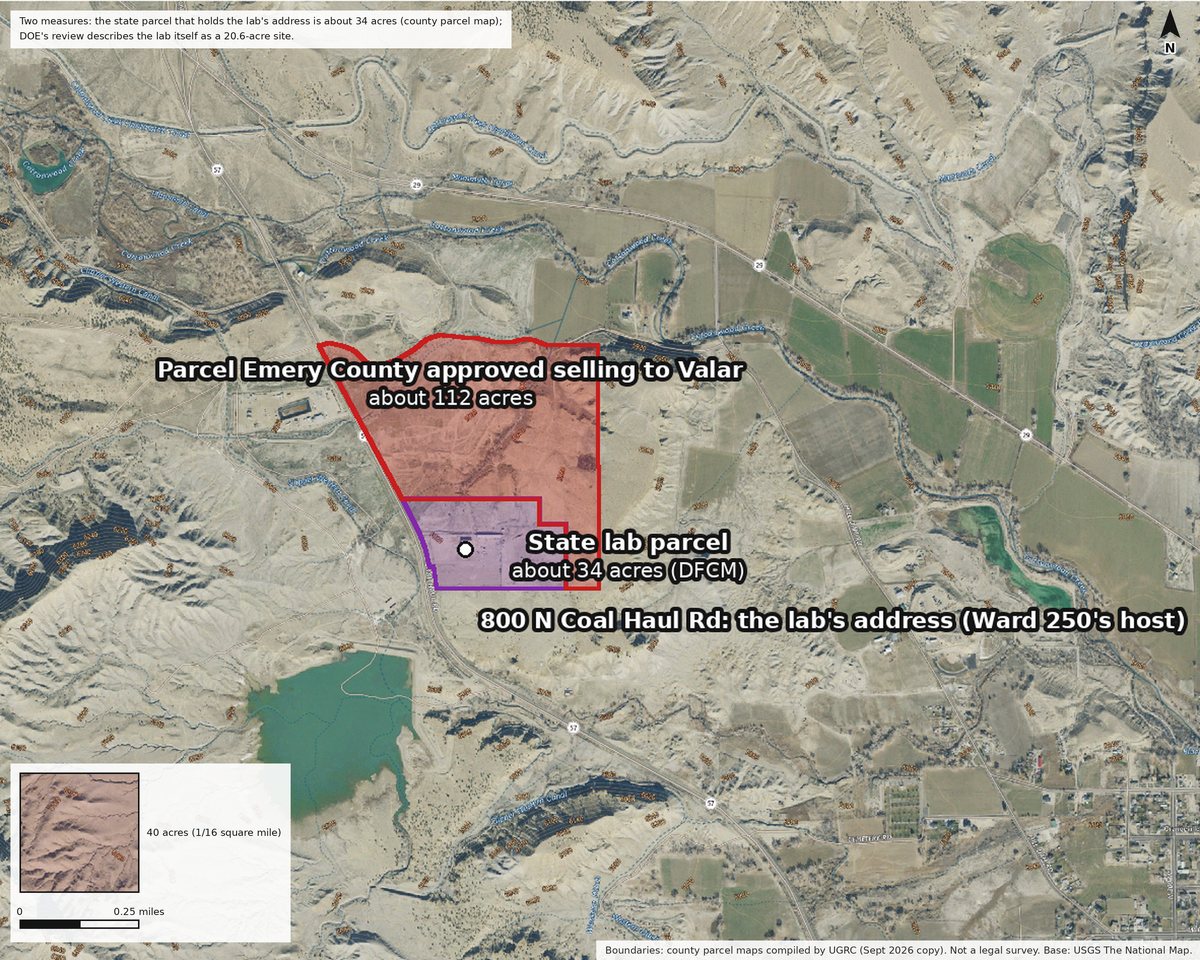
The accident math assumes the public stays 400 meters away. The lab it sits on is about 20 acres.
Keeping everyone 400 meters back would take about 124 acres. No record read says the public is kept off the land beyond the lab. Valar has since bought, or is buying, about 110 acres north of the lab; no record read says whether that covers the 400-meter circle. The 400 meters is the distance Valar's draft safety paper uses for its public-dose math and calls 'the nearest point of public access'; no DOE record read makes it a required boundary, and DOE's review says access is controlled during operations without saying where.
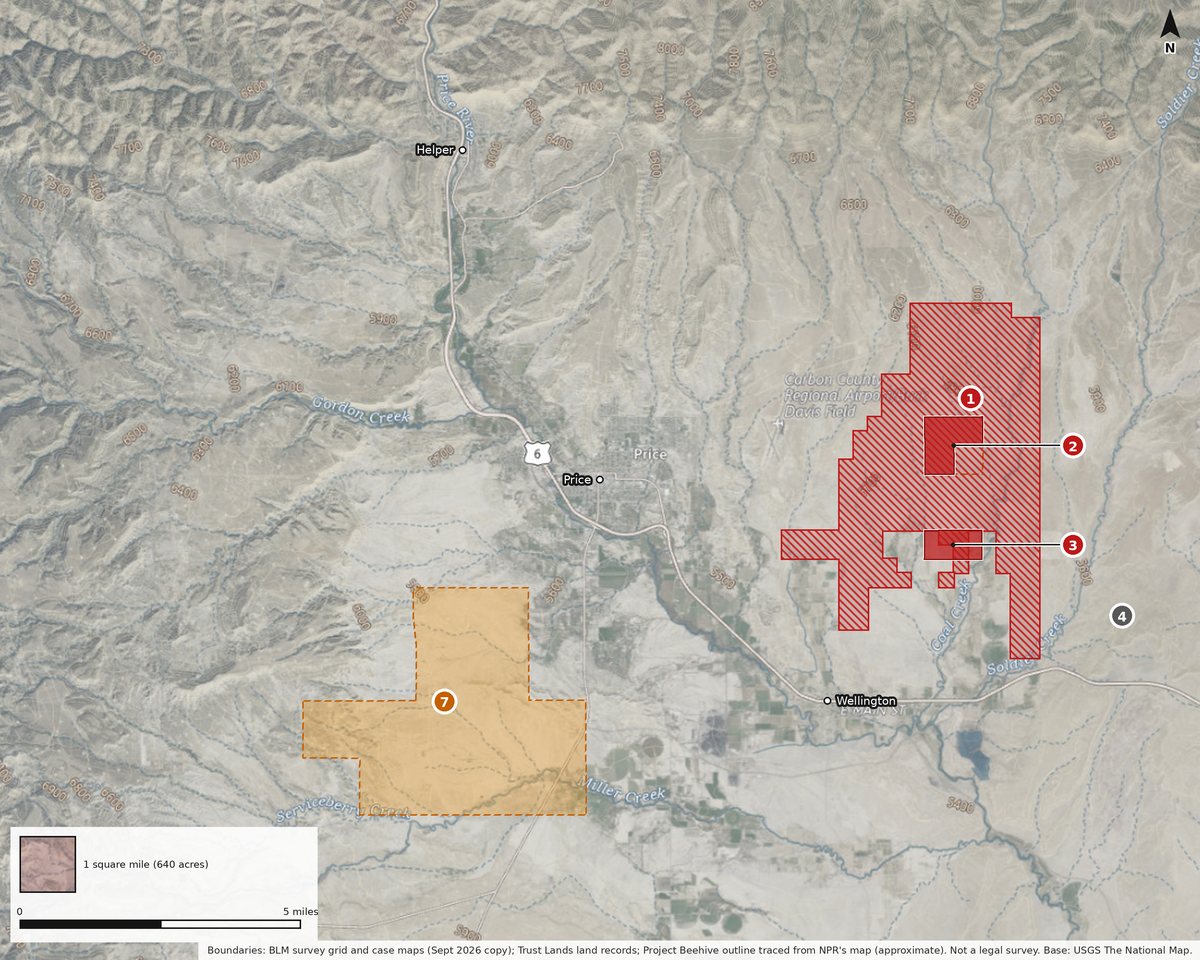
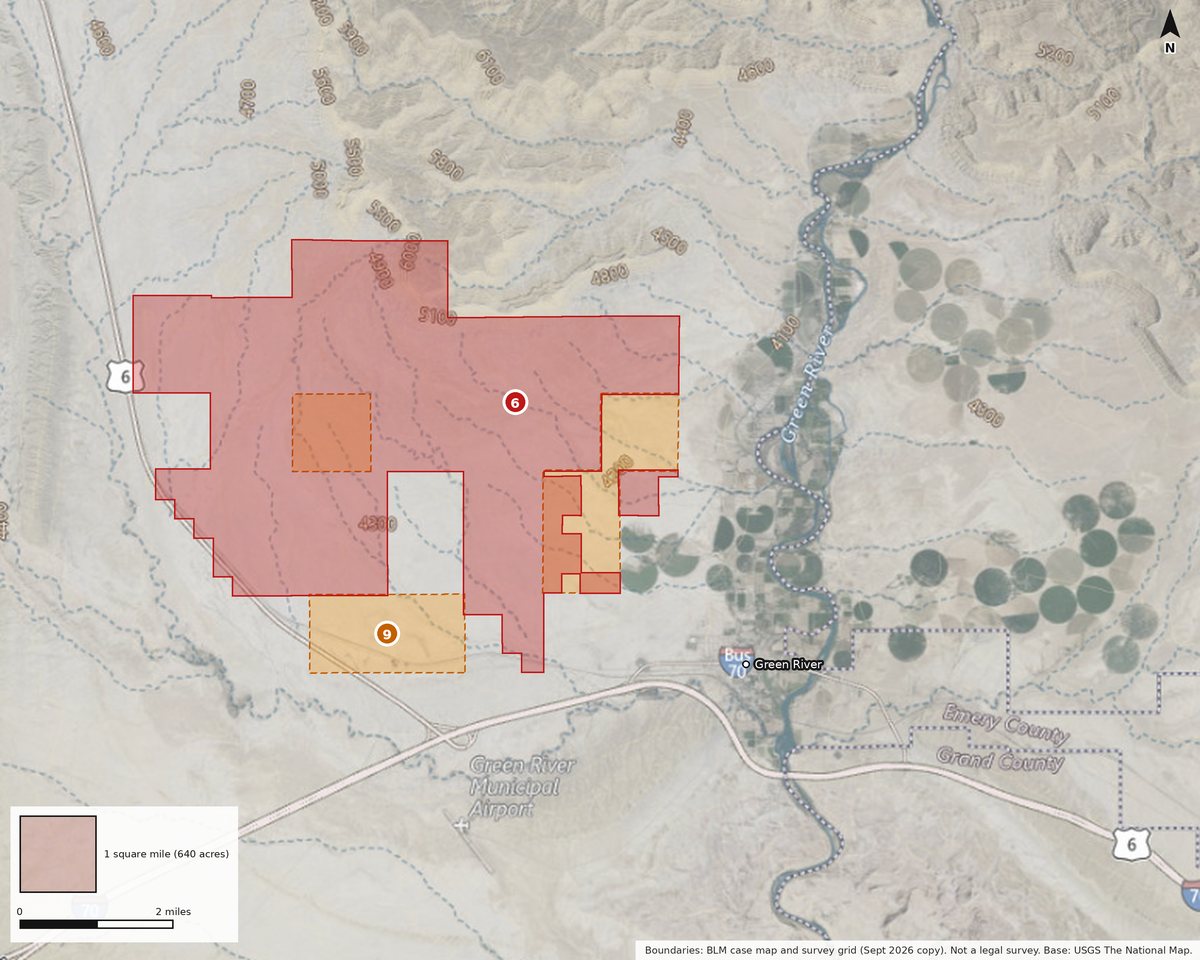
Project Beehive: NPR reports a plan for about 456 reactors on more than 9,000 acres of federal land near Price.
NPR reported on 30 September 2026, citing a Valar proposal to federal regulators that it reviewed, that the plan also includes data centers, a nuclear fuel facility and places to store nuclear waste, with the first reactors in 2028. BLM told NPR it is reviewing the application for completeness. The proposal itself was not found in public records.
Spent fuel is barred from the leased land, but the deal lets Valar buy part of it for interim spent-fuel storage, if licensed.
The state's slides told the Trust Lands board that nuclear waste storage is 'strictly prohibited on the lease'. The memo's terms add a purchase route: Valar must first buy any portion it needs for 'interim storage of spent fuel', and that storage would need federal and state licenses. Valar officials have said used fuel from the Carbon County project would first be stored on site in dry, sealed casks under federal licensing, and that a future national storage or disposal option could eventually be used, but no specific long-term disposal site outside the area had been identified (ETV News); NPR also reports waste storage at Project Beehive's site, and no written storage plan was found in public records. Whether Utah's limits on high-level nuclear waste reach used fuel stored at a reactor is not settled in any record read.
How much used fuel that could be, and how strong it stays: Radiation Exposure →
Up to $106.7 million in state tax credits for Valar, payable only if a local incentive is also approved; none has been found.
The credit is paid only after new state tax revenue comes in, and the board's terms require a local incentive approved by its Incentives Committee. At Emery County's April 7, 2026 hearing, the minutes record that the county had given Valar no incentives and that Valar had not asked for one. The board's agendas named none of its 13 tax-credit applicants from April to September 2026; Valar's was handled the same way.
More findings (6) The rest of what the records show, each with its evidence.
No public copy of the reactor's approved safety analysis was found.
No approved safety analysis, operating limits, DOE review of them or signed startup approval was found posted, and DOE's occurrence-report database is closed to the public. DOE has said federal teams reviewed contractor safety submittals for the pilot reactors and took part in Ward 250's readiness review before startup; the review documents themselves were not found. Valar, which calls itself 'very open and transparent', has published its draft safety design agreement and its quality program.
The safety papers credit prototype tests whose data were not found in public records, and the page titled 'Ward Zero Whitepaper' holds no Ward Zero data.
Valar's safety agreement credits its non-nuclear prototype, Ward Zero, for key safety points, such as cooling without pumps. No published Ward Zero test data was found. An unlisted page titled 'Ward Zero Whitepaper' contains no Ward Zero data; its text matches a 2019 essay on reactor exports by another author. It may be leftover placeholder text (Valar has not said), and it is still online.
No NEPA environmental review open to public comment.
DOE used a 'categorical exclusion': no environmental assessment or impact statement and no comment period on the project, despite formal objections to the exclusion to which DOE had posted no response. The exclusion is the environmental (NEPA) step only; DOE's safety approval of the reactor is a separate process.
Local checks: district minutes record a staff report of a sewer tie-in 'without prior authorization', and the state declined to review the reactor building's fire plans.
The water district's approved minutes record a staff report that Valar 'tied into the county sewer system without prior authorization' and that its sewer plans 'were not submitted to the State as required'; the request was for restrooms only. No Valar response or later resolution appears in the record read. For the reactor building's fire-code review, state agencies declined to review the plans and recommended a third-party review, and the county has no fire inspector. The March minutes say it 'has been addressed with chiefs and is not currently a concern', not how.
A lease of up to a century for a nuclear campus north of Wellington; its bid notice and first state posting did not say 'nuclear'.
The state's bid notice and its April posting for agency comment named neither Valar nor a nuclear use; the board packets for the August and September hearings did. Carbon's commissioners signed a support letter; how it was approved is not in the records read. The hearings were in Salt Lake City, with online attendance possible, and no comment opposing the lease was recorded.
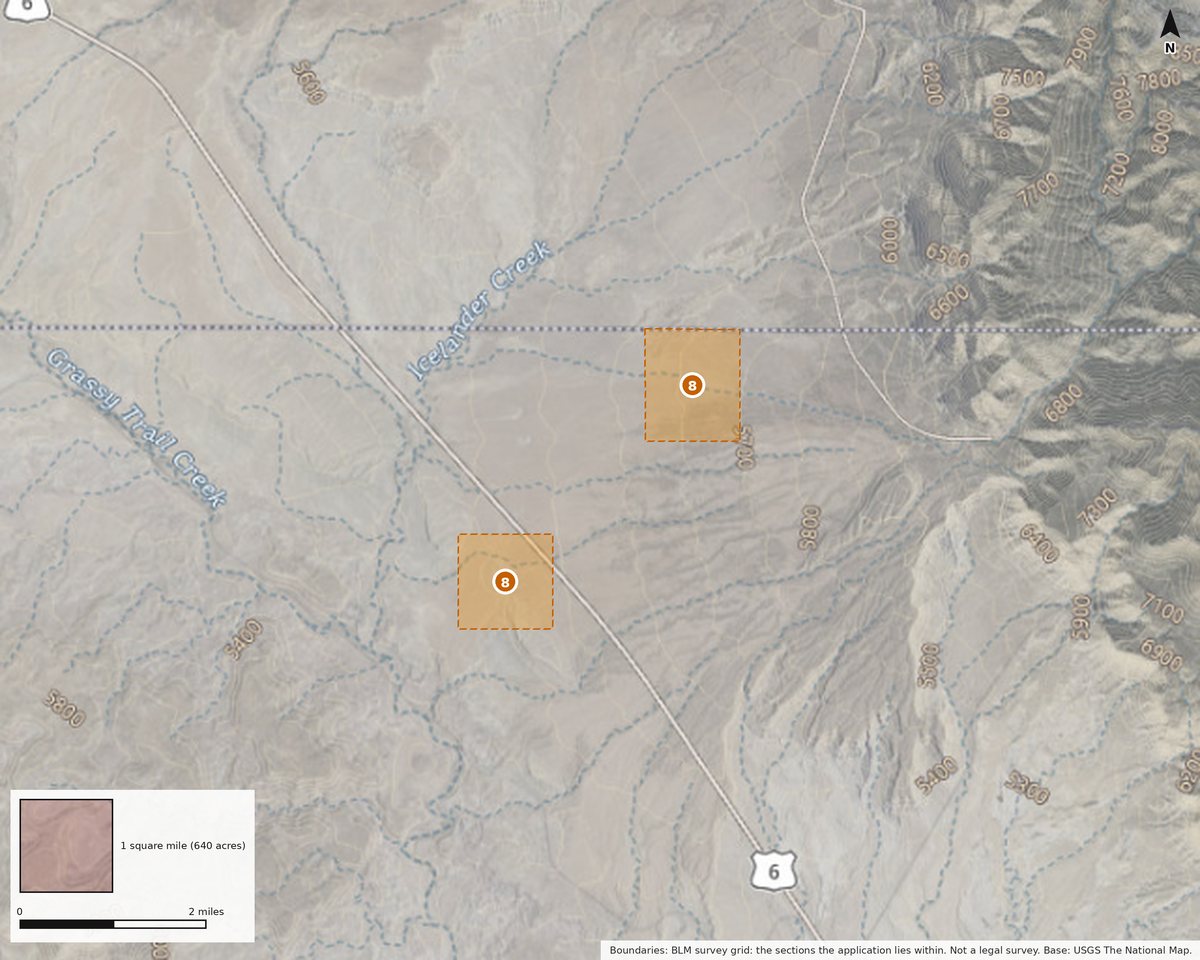
A mining claim two miles from the approved lease site, where the only nearby mineral records are gravel pits and a carbon dioxide field.
A Notice of Location names Valar Atomics Inc as locator of the RW 453 lode claim (12 Sept 2026). Public mineral records for the area list only sand-and-gravel pits and a carbon dioxide field; a claimant may know of a mineral showing those records do not list. The county and BLM filings due in October and December will state what is claimed.
What holds up: DOE did authorize the reactor, DOE says federal teams reviewed its readiness before startup, it reached criticality on 18 June 2026 (ahead of the 4 July goal), it was flown in without fuel, DOE checked the fuel's shipping package, and DOE says the fuel type, TRISO, is 'more resistant to neutron irradiation, corrosion, oxidation and high temperatures' than traditional reactor fuels. And a Valar plan for a Carbon County manufacturing hub was in the local paper in October 2025, though no local record read from before the state's vote tied Valar to the site. safe-039 loc-034 dir-031 orig-010
About these records
Public records change. Agencies update their databases, move pages, restrict access and take documents down, often without notice. Every item on this site is as accurate as the public record allowed on the date shown with it, and every line links to the record it rests on.
We keep saved copies of the sources we read. When a record we cite changes, moves, becomes harder to reach or disappears, we note it on that item rather than quietly rewriting it.
If a fact or a calculation here is shown to be wrong, we correct it and say what changed and when. Every calculation shows its inputs and its steps, so anyone can check the work.
When a check is found to be incorrect via sources and evidence that concretely refute it, a correction will be posted.
This is an independent fact-check of public records. It is not legal, tax or financial advice.